Friday, January 24, 2014


The Panama Canal celebrates 100 years of service in 2014.  On a trip across the continent, we see first hand some of the results of that monumental construction project.


Control building on the Pacific side of the continent.
We rise before the sun, launch our kayak, paddle to the dinghy dock, catch a cab and we are soon comfortably relaxed in the club car waiting for the train to depart.

The Pacific side of the canal is familiar from a short excursion aboard Kalliope and from living here for about three months.  The salt water on either end of the canal consists of shoals that extend out from the shore and of canals dug at sea level to carry ships through these shoals and some distance into the interior where the first set of locks is located.

A ship passing through the shoal area as it leaves the Pacific for the Canal.

Deb and Gregg want to see more of the Canal and do not plan to pass through with Kalliope, so we take the train along a route that roughly parallels the Canal.  The Panama RR dates from 1855 though most of the route was relocated many times.  Note that the RR and Canal run south from Colon on the Caribbean to Balboa on the Gulf of Panama, an extension of the Pacific Ocean.  The trip across the continent at this point is about 45 miles or about two hours long.


We find Gatun Lake to be very inviting with wide expanses
 of calm bays dotted with islands covered with lush vegetation.

A great deal of heavy equipment is moored or working on
 Gatun Lake to maintain the depth and width of the
 passage through the lake and keep the buoys and other
aids to navigation in good working order.

The construction of the expanded lock system is currently one and one half billion U.S. dollars over budget and the private contractors are negotiating with the government of Panama to determine if the work will stop on January 25, 2014 or the government will certify payment.

Lock gates to be installed in the canal expansion project.
The historic tome "Path Between the Seas" by David McCullough enhances our understanding and appreciation of the canal and the changes it brought to this former Columbian provence.
The rolling stock on the Panamanian RR is comfortable
and attractive.  This is a must-see on your Panamanian
vacation.
We cross to the Caribbean by train and return by bus arriving in Balboa by eleven a.m. and wondering what projects to tackle in the afternoon.

Thursday, January 23, 2014

For Cruisers Only

Someone asks about the passage from Panama to Costa Rica.  They are eager for info and I am happy to relate our impressions but the time and the place don’t come together.  I decide to post a few notes and point interested cruisers to this blog.

Deb and I leave Playa del Coco, Costa Rica for Panama in September, 2013.  This narrative is in reverse sequence for the convenience of cruisers who spent December and January in Panama and now plan to sail to Costa Rica and beyond.

Bahia Honda:  07 45.8N 81 32.7W  This large well sheltered bay surrounded by high, lush green hills is marked by the occasional fisher or farmer who will stop by your anchorage in a well worn boat to chat and possibly sell you some produce or try to mooch some commodity that is hard to get in this remote spot with no road.  We stayed only two nights and did not visit the village, but we would happily return and stay longer.  If possible, explore the channels through the mangroves in the NW corner of the bay at high tide

Isla Coiba:  07 35.6N, 81 42.8W  This is an undeveloped, unspoiled National Park where we pay $125 per night to visit.  Word of mouth suggests that many cruisers who stay in the southern and Western portions of the island group never see the ranger and never have the chance to pay.  Expect to find sand bottom anchorages sheltered on one side and exposed to wind and sea on the other side.

Puerto Armueles: 08 15.8N, 82 51.4W A port of entry/exit for Panama with only an open roadstead with poor holding.  We found the town poor but pleasant.  After reviewing our experience with customs, immigration, etc. we plan to never return.

Punta Balsa:  The Panama/Costa Rica border.

Golfito:  This is a Costa Rican port of entry where the various offices are dispersed but not too far apart and the personnel are helpful.  Talk to some locals about the procedure and plan to spend a few dollars on taxis.
Sea/Land at Golfito

 This former banana shipping port has some shore facilities attractive to cruisers.  The Banana Bay Marina has a nice bar/restaurant and there is a good Chinese restaurant downtown. We take a mooring at Land/Sea services next door to Banana Bay.  Land/Sea is a fun, economical and friendly business.  It is the marine equivalent of a B&B where you stay on your boat, but you have access to their fridge, wi-fi, TV lounge, five dogs and local knowledge.  We had no trouble but there were enough warnings of theft from cruisers to keep us cautious.

Drake Bay:  08 41.9N 83 40.4W  We spend three nights in this spacious bay with good holding in sand and many local boats.  As we paddle to shore and up the stream to the west, we meet a crocodile paddling out into the salt.  This is our introduction to a very pleasant day of hiking a waterfront trail in the Osa Peninsula National Park, then visiting the village for a nice meal in an open air restaurant.  Isla Cano, ten miles to the west requires reservations on the internet before you arrive.  It serves mainly fast pangas full of tourists who come out for a day of snorkeling.

Quepos: 09 25.69N, 84 10.46W  It is possible to anchor in  Manuel Antonio park on the N side of the peninsula.  It takes a bit of nerve for us to feel our way among the rocks and reefs to the sandy anchorage.  Some swell rocks us to sleep in mid-September.  There is allegedly a fee to anchor in the park, but we did not find anyone to collect it.  It should be OK to take a tender to shore, then walk the well-marked trail out to the gate to pay the modest daily fee.  We have to meet some folks and take on fuel, so we go to nearby Marina Pez Vela where we pay $125 a night in the new marina with easy access, wide open fairways and a short walk to a town with nice restaurants, but not a lot of character.
Approaches to Anchorage Manual Antonio Park


Puntarenas: 09 58.9N, 84 47.8W  As the guidebooks say, the only reason to visit here is for fuel, water or repairs.  It is a city of poor people with little to appeal to cruisers.  The Costa Rica Yacht Club is a bright spot with pleasant staff and nice bar/restaurant.  They sent a pilot in a small skiff to guide us about five miles up the river between the town and the mangroves to reach the club.  Expect moorings fore and aft, substantial tidal current and some risk of grounding at low tide.

Ballenas Bay: 09 42.60N, 84 58.48W  This is a calm harbor with plenty of room to anchor and good holding in sand.  There may be a minor conflict with long line fishing gear near the small village on the south side of the bay.  Dinghy landing is easy on sand & rock beach.  The people here are not hostile but not friendly.  We leave Kalliope at anchor for 12 hours at a stretch and it stays safe.  Ashore we make our way to Punta Blanca Absolute Parque National where we have a pleasant hike and commune with the monkeys.
 
Fishing Village in Ballenas Bay
Golfo Papagayo: The popular destination here is Playa del Coco, a small tourist-oriented town with a popular beach, a rather exposed anchorage, four modern markets, abundant restaurants, souvenir shops, dive shops, port captain customs and 732 pelicans.  Though this is a port of entry/exit, it is necessary to visit customs twelve miles away near the Liberia airport.   We take about three days to get to customs and no one complains.  No officials charge any fees.  Taxis are expensive, buses are inconvenient and rental cars cost less than in California.  We could be happy spending a whole season in Golfo Papagayo.

A few miles from Playa del Coco is the very comfortable Bahia Culebra where Kalliope passes a pleasant two months of the “rainy season” July and August without suffering lightning, excessive rain or high winds.  In this well protected bay, you can chose from seven pleasant sandy beach anchorages or one marina.  We use the less developed Playa Panama anchorage and Playa Hermosa where there are laundry facilities, restaurants and a bit of social activity along the beach.

Also in Golfo Papagayo are the Islas Murcielagos or Bat Islands 10 51.5N, 85 54.5 W where we spend several wonderful days diving, hiking and watching the turtles.  There is a fee for use of this Parque National Santa Rosa but we find no one to collect it.  This is a must-see.

Playa Blanca 10 50.3N 85 47.4W just N. of the Bat Islands is a delightful place where we are all alone in late August.  There is likely to be enough surf here to make landing the tender a challenge, but the beautiful beach and unspoiled wildlife make it worthwhile.  It is possible to walk along an overgrown jeep trail toward the next bay and observe monkeys, birds and snakes.  North of this bay, our path is offshore, so we cannot offer any insight except for Amapala, Honduras in the Gulf of Fonseca and Puerto Chiapas in Mexico.


A shore excursion of several days to Costa Rica’s Lake Arenal region is highly recommended.  Would you believe this is cattle country?

Tuesday, October 1, 2013


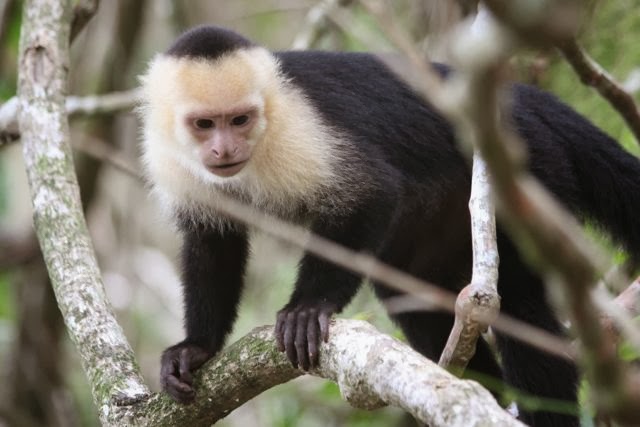
White-face monkeys - guardians of the beach in Manuel Antonio National Park


Manuel Antonio National Park


Three Toed Sloth in Manuel Antonio National Park


Mantled Howler Monkey in Punta Blanka Absolute National Park

September 17, 2013

Today Kalliope is at the marina in Quepos, Costa Rica and we enjoy walking in nearby Manuel Antonio National Park.  The density of wildlife is remarkable considering the press of human visitors.  All guests enter on foot and there are many guided groups.  We take our cues from some of the guides.  When they spot insects, birds, reptiles or mammals, we point our camera accordingly.  This is a small jungle and beach park and we cover most of the trails.  The section that gets the heaviest use is a narrow isthmus with nice swim beaches on each side.  When we arrive here we are surprised to find lots of animals and soon it is clear they are drawn by the food people bring in.  No one appears to feed the animals, but raccoons get into the trash and monkeys pilfer apples from beach blankets.  Raccoons also raid packs and purses for food.  I sit down to eat an apple at a picnic table and three white faced monkeys descend from the tree above.  They are not too aggressive but when one comes within two meters I stomp my foot and he retreats up the tree a bit.  When I look west, a raccoon climbs up on the east end of my bench and a helpful tourist chases him away.
We finally get to spend time with mantled howler monkeys and white-faced monkeys. Yea!


Hump back whale lounging in Ballenas Bay near Puntarenas, Costa Rica

Deb in Rincon de la Vieja National Park, Costa Rica

August 9, 2013

Well Deb, the activities director, is back from New York and she wants to visit the highlands to see what the ‘other half’ of Costa Rica looks like.  We rent a car and take a day trip to the volcano park called Rincon de la Vieja.  We have a nice hike but don’t see any monkeys and the trail to the volcano is closed. Significantly the road to the volcano passes a large and apparently complete geothermal electric power generation station.  We did not discover how much power is generated here.  This park is close to Playa Hermosa and Kalliope so we return there for the night.

The next day we drive to a place called Monteverde.  It is a reserve originated by Americans who left what they considered a militaristic country in 1948 for Costa Rica where there is no military.  They are Society of Friends, also known as Quakers and are now dairy farmers.  Well, one second generation Quaker is the part time naturalist who guides our morning nature walk.  When I ask him if the number of Friends is growing, diminishing or what he thinks a minute and says: “It is hard to say because we may have 50 people at the Sunday morning meeting but if you ask them afterwards if they are Friends, most of them will say no.”


In Monteverde we see mostly insects, mollusks reptiles and plants of every description

Monteverde is simply an upland area set aside to preserve the biodiversity and protect the water sources for downstream farming and ranching.  A concession in the reserve provides upscale dormitory rooms, meals, guided nature walks and souvenirs.  We opt for room and board and tour.  We see birds, frogs, snails, waterfalls, stick bugs and orchids on our short guided walk through the Jungle.  We see no monkeys.  After a longer walk on our own, we head out toward the next attraction, the Arenal Volcano.  It is a short distance away but to get there we drive around Lake Arenal, the largest lake in Costa Rica.  This is not a short drive and we arrive the next day.  The area around the lake is cattle country, fairly open with wide vistas and forested mountains in the background.  Lake Arenal provides hydro power to San Jose but hundreds of large wind generators are more visible evidence of renewable energy generation for Costa Rica.  These line the ridge south of the lake and apparently take advantage of the strong ‘winter’ winds that make Lake Arenal a Mecca for windsurfers and kite boarders.  Winds are light during our visit.  We spend about three nights in this area staying in lodges near the parks.

Dear Debbie:                                                                                                         July 22, 2013                                                                                                                                         

Hope you are enjoying NY?  It was early to bed last night and up before dawn this morning.  I load the tender with laundry, etc and paddle to shore.  At the picnic table where I leave the tender, I meet an Ecuadorian man who would like to sell us an excursion, etc. and meet a firefighter from Mesa, AZ who just retired and moved into a nice house on the hill overlooking Bahia Culebra.  We chat a few minutes and exchange phone numbers to get together later.
I drop the laundry off at the “LavenDaria” in Playa Hermosa and grab a box of juice next door.  

Then I start the hike over the hill to pueblo Panama where I heard there is a seamstress.  She is the sister of Jesus, the shave ice man at Playa Panama.  When I asked Jesus last week if there is a tailor in Sardinal where he lives he said: “Yes, but there is one closer.  Anna is my sister and lives in pueblo Panama.”  Well, to make a long story medium, I walk up to the convenience store at the bus turnaround in Panama and the lady at the cash register speaks English but if she knows Anna she won’t tell me.  As I walk along what I think is the right road, a guy with a machete in his hand stops to ask me for a buck.  “Sorry, no.”  I ask a lady burning trash in the street about Anna and she says to go a hundred yards further, turn left and ask the lady: “Donde vive Anna.”  I think I will either find Anna or her next door neighbor.  No, I find the other lady in Panama who speaks English.  She sends me back to the convenience store and 300 yards the other direction where I find a rather suspicious Anna on her front porch.  I think word of my quest got there ahead of me.  I explain from the sidewalk that my pants are too big.  She invites me to the porch and I show her the slacks.  She ponders a while, introduces me to her brother or maybe husband and I tell her I found Jesus at the beach and Jesus sent me to her.  A ha! She promptly measures me, drags the sewing machine table to the front porch and does the work right there on the spot.  Then we start to talk price.  I think the price went up three times during this conversation, but $12 still does not seem so bad for taking in three slacks.

When I return to the convenience store the bus is there but the driver is asleep in a hammock hung from the posts of the bus shelter.  All of the usual loonies and the guy with the machete are gone.  After consulting my schedule, I find the bus will leave in 40 minutes.  I don’t want to walk to Playa Hermosa, so I go to the other store in pueblo Panama, buy another juice and plop down in the chair out front where I enjoy the breeze and watch the chickens, dogs and children of the neighborhood while I wait for the bus.  This excursion is mostly to help me get acquainted with some Ticos.

Back at Playa Hermosa I walk the very pleasant promenade through the trees between the sand of the beach on one side and the mixed homes, restaurants and hotels on the other.  Friendly people try to sell me fishing trips, ceramic bowls, volcano trips and massages.  When I turn them down, they smile, wish me a good day and move on.  No one offers to rent a sail board, the one thing that might have emptied my pocket. 

I toss my pack with the skinny pants into the kayak and decide to paddle to the rocks at the end of the beach.  The tide is high, the surf is low and water clarity is so-so.  I see a few fish but no starfish, eels or urchins.  I know you would love to snorkel here.  Most of the boats in this bay seem to have two or three resident pelicans but your scarf fluttering from the forestay has kept them off Kalliope so far.  I wonder if they take it for a bigger badder bird.  The boat is a mess, the heat is oppressive and I am not having any fun.  Don’t you wish you were here?  I miss you something awful.  Come home soon.

Dear Debbie:                                                                                                                  July 21, 2013

Kalliope and I move from Playa Panama to Playa Hermosa today, ostensibly to be closer to a laundry, but the real reason was an excuse to go sailing.  So, I take seven and one half hours to go three quarters of a mile.  Call it the long way home.  Along the way I see a pair of pan tropic spotted dolphins performing a water ballet and a manta ray practicing his double back flip.  A school of mackerel jumps out of the water as if that is the best way to get somewhere, but they are not coordinated like the dolphins.  I spend an hour waiting for wind (drifting) at the entrance to the Papagayo Marina.  If it makes them nervous, they didn’t mention it.  Later I spend a pleasant hour studying the crowded bay to get the perfect spot to anchor.  By now, I am almost used to pulling the shift lever back when I want to go forward, an unintended consequence of the transmission rebuild.

Playa Hermosa feels a bit like a fishbowl after Playa Panama.  The hills are steeper and the bay is smaller.  There is more development on the hills and I am a little self conscious taking my shower in the cockpit after my evening swim.  It feels like every one of those condo windows is a pair of eyes staring right at me.  Makes me consider wearing swim trunks next time.
Returning the clean laundry to the cabinets, I am convinced that we have reached the tipping point and now have more stuff on board than a 37 foot boat can hold.  Speaking of whining, a solitary mosquito nearly bleeds me dry in the night.  If you were here, it would have bitten you and I would be safe.  Come home soon
Love, Gregg

Yes two letters to Deb are included intentionally.